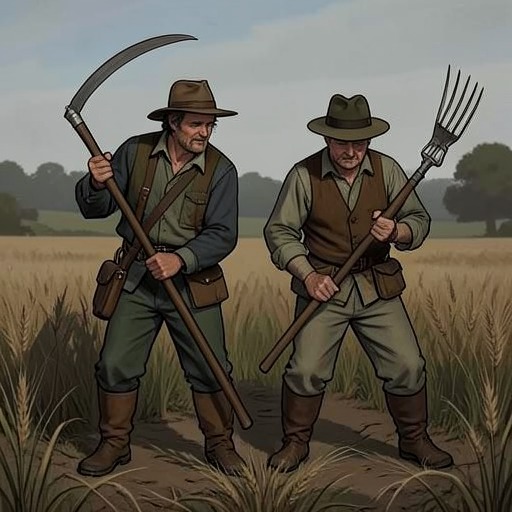
Gabriel Oak rescues Bathsheba’s clover-bloated sheep
Far from the Madding CrowdGabriel Oak rescues Bathsheba Everdene’s clover-bloated sheep in a crisis that makes practical skill, animal suffering, and personal pride inseparable. Fifty-seven sheep have strayed into young clover and developed dangerous distension; as animals begin to die, Bathsheba must summon the shepherd she had forbidden her household to mention. Gabriel returns only after she asks him properly, then uses a trocar to relieve the flock. The rescue saves most of the sheep and ends with Bathsheba asking him to stay on with her—a professional reconciliation charged with the unspoken history of their relationship.
Causes and Immediate Danger
On a Sunday afternoon, men from the farm rush to Bathsheba with news that sheep have broken through a fence into a field of young clover. They report that the animals are becoming dangerously bloated and may die unless removed and treated. Bathsheba is on her way to church; she throws aside her parasol and Prayer-book and runs to the field. Her authority as the farm’s mistress is immediately tested by a crisis that neither command nor concern can resolve by itself.
The afflicted sheep are swollen, many lie helpless, and some foam at the mouth with quick, short breathing. The men explain that the animals must be pierced at a precise point in the side: a mistake of even an inch could kill an ewe. They do not know how to perform the operation. Joseph Poorgrass identifies Gabriel as the only nearby shepherd with the necessary knowledge, and the men recall that Boldwood had previously sent for him to treat two of his own sheep after they got into vetches. Bathsheba, still angry with Gabriel, refuses at first to have him summoned.
The danger grows while she insists on that refusal. One ewe contracts violently, leaps into the air, falls, and dies; another later springs up and also dies. The mounting losses expose the contradiction between Bathsheba’s pride and her responsibility for the flock. Her declaration that she will not send for Gabriel proves less settled than the need before her: she follows the men, asks where he is staying, and orders Laban Tall to ride across the valley to Nest Cottage.
A Failed Command and a Changed Appeal
Bathsheba’s first message is an order: Gabriel is to return instantly because she says so. Tall rides to the cottage and comes back without him. Gabriel’s answer is that he will not come unless Bathsheba requests his help civilly, as a woman asking a favour. The condition reverses the posture of her command. She objects that she should not have to beg a man who once begged her, but the dead and dying sheep leave no room for that dispute to remain merely personal.
As another ewe dies, Bathsheba turns aside in tears. William Smallbury suggests that she ask more softly, assuring her that Gabriel is a true man in that respect. She stops trying to conceal her grief, goes indoors with Tall, and hastily writes a note. It is polite, but its added closing line makes the appeal more than a formal request: “Do not desert me, Gabriel!” She looks at the words before folding the note, and the narrative connects her choice to the uneasy recognition that the strategy may not be entirely just. The message gives Gabriel the civility he required while revealing how much Bathsheba needs his presence.
During the anxious quarter-hour before the horse returns, Bathsheba cannot bring herself to watch. She leans over the bureau where she wrote and closes her eyes against both hope and fear. Gabriel arrives and rides directly toward the sheep. Bathsheba meets him with gratitude, though her words still take the shape of a tender reproach for his earlier delay. He gives a confused reply and hastens to work; she understands that it was the final sentence in her note that brought him.
The Operation and Its Results
Gabriel strips off his coat, rolls up his sleeves, and takes a small trocar from his pocket. He feels along each sheep’s left flank to find the proper point, pushes the lance through the skin and rumen, then withdraws it while leaving the tube in place. Air rushes out through the tube, relieving the pressure that has left the animals distended and helpless. The account dwells on the precision of this farm knowledge: the procedure is compared to surgical dexterity, yet it is Gabriel’s practical shepherding skill, acquired through work with livestock, that makes it possible.
In the hurry, with some sheep already far gone, Gabriel performs forty-nine operations successfully. He misses the proper point once and mortally wounds that ewe. Four sheep have died, while three recover without an operation. The total number that strayed into the clover and became dangerously ill is fifty-seven. The outcome is therefore a substantial rescue, not a flawless one: Gabriel’s expertise limits the losses, but urgency and the animals’ condition leave death within the scene even as relief becomes visible among those he treats.
The episode’s concern for the flock has particular force in light of Gabriel’s earlier ruin. After his own uninsured sheep fell into a chalk-pit, he pitied the ewes and their unborn lambs before fully taking in that the disaster had destroyed his hopes of becoming an independent farmer. That earlier loss joined animal lives to the precarious economics of farming; here, Bathsheba’s flock likewise represents both vulnerable creatures and the substance of her farm. Gabriel’s response to the animals is not reducible to their value as property: the scene shows him laboring to relieve their suffering while accepting the risks of hurried treatment.
Consequences and Significance
When Gabriel finishes, Bathsheba comes to him and asks whether he will stay on with her. He agrees, and she smiles. The exchange restores him to the farm after his departure and follows directly from the dependence the crisis has made undeniable: Bathsheba needs the knowledge he possesses, while Gabriel’s readiness to serve her is bound up with his enduring attachment. His return is not granted by her authority alone; it follows her recognition that she must request what she needs.
The rescue thus turns on a double reversal. Bathsheba begins by treating Gabriel’s return as something she can command, but the flock’s worsening condition forces her to acknowledge the limits of that power. Gabriel, who could have made her wait, comes after the appeal that asks him not to desert her. The livestock crisis becomes a test of pride and a renewed bond of work, while the successful treatment leaves the relationship unresolved: Bathsheba accepts Gabriel’s service and asks him to remain, but the scene does not make her answer his love. Its decisive outcome is narrower and more concrete—most of the sheep survive, and Gabriel resumes his place at her side on the farm.